
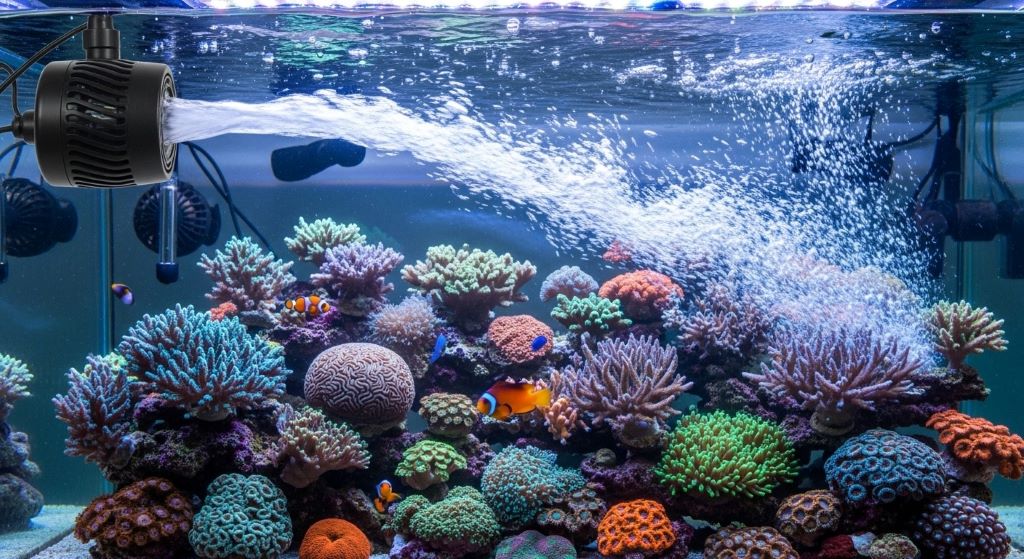

Creating a thriving reef aquarium requires more than just clean water and proper lighting. Water movement plays a crucial role in coral health and growth. The way you position your pumps determines whether your corals will flourish or merely survive. Understanding how water flows through your tank and how different corals respond to current helps you create the ideal environment for your underwater ecosystem.
Many aquarists underestimate the importance of proper water circulation. They invest in expensive equipment but place pumps randomly without considering flow patterns. This approach often leads to dead spots where debris accumulates and areas with excessive current that stress corals. Learning to position your pumps correctly transforms your reef tank from mediocre to magnificent.
Why Water Movement Matters in Reef Tanks
In nature, coral reefs experience constant water movement from ocean currents, waves, and tides. This movement serves multiple essential functions that you need to replicate in your aquarium. Water flow delivers nutrients to corals, removes waste products, and prevents debris from settling on coral tissue.
Corals feed by capturing microscopic food particles from the water column. Adequate current brings these food sources directly to coral polyps. Additionally, flow helps corals expel waste and excess mucus that could otherwise harbor harmful bacteria.
Water movement also prevents dead zones where oxygen levels drop and harmful gases accumulate. Stagnant water creates conditions where algae thrive and corals struggle. Proper circulation ensures consistent water chemistry throughout your entire tank.
Furthermore, many corals extend their polyps and display their best colors when they receive appropriate water movement. The gentle swaying motion stimulates natural feeding responses and promotes healthy tissue expansion.
Understanding Different Coral Flow Requirements
Not all corals need the same amount of water movement. Some species come from shallow reef crests where waves crash constantly. Others grow in protected lagoons with gentler currents. Matching flow intensity to your specific coral species is essential for success.
Soft corals like mushrooms and leather corals generally prefer moderate to gentle flow. These corals have flexible tissue that sways gracefully in mild current. Too much flow causes them to remain closed and retracted. They need enough movement to prevent debris accumulation but not so much that they cannot extend their polyps.
Large polyp stony corals such as brain corals, favia, and acans also appreciate moderate flow. These corals benefit from rhythmic water movement that mimics natural surge patterns. Direct, constant flow from a single direction can damage their delicate tissue over time.
Small polyp stony corals including acropora, montipora, and stylophora typically require stronger flow. In nature, these corals dominate high-energy reef environments. They thrive when positioned in areas receiving robust, turbulent water movement. However, even these corals need varied flow rather than a constant blast from one direction.
Zoanthids and palythoas fall somewhere in the middle. They tolerate a wide range of flow conditions but generally perform best with moderate current. Too little flow allows debris to settle on their mat, while excessive flow prevents them from fully opening.
Choosing the Right Pump for Your Tank
Before discussing placement, you need to select appropriate pumps for your aquarium size and coral collection. The general recommendation is to aim for 10 to 20 times your tank volume per hour in total flow. A 50-gallon tank would therefore need pumps providing 500 to 1,000 gallons per hour combined.
However, this guideline varies based on your coral selection. Tanks dominated by soft corals and large polyp stony corals can function well at the lower end of this range. Aquariums housing primarily small polyp stony corals often benefit from flow rates at the higher end or even beyond.
Using multiple smaller pumps rather than one large pump creates better circulation patterns. Two or three pumps allow you to direct flow from different angles, creating the turbulent, chaotic movement that corals love. This approach also provides redundancy in case one pump fails.
Consider pumps with adjustable flow rates and wave-making capabilities. These features let you customize current patterns and create the pulsing flow that mimics natural ocean surge. Many modern pumps offer preset modes that alternate between different flow patterns throughout the day.
Basic Pump Placement Tips for Beginners
When positioning pumps in your reef tank, start by understanding basic principles that apply regardless of tank size or coral selection. These fundamental reef circulation tips help you avoid common mistakes that compromise coral health.
Place pumps near the top of your tank rather than at the bottom. Surface agitation created by pumps positioned high promotes gas exchange, releasing carbon dioxide and absorbing oxygen. This placement also creates a top-to-bottom circulation pattern that reaches all tank areas.
Avoid pointing pumps directly at the substrate. This creates sandstorms that stress corals and cloud your water. Instead, angle pumps slightly upward or parallel to the glass. The flow will naturally deflect and create circulation without disturbing your sand bed.
Position pumps on opposite ends of your tank when using two powerheads. This creates a figure-eight flow pattern as water from each pump meets in the middle. The colliding currents produce the turbulent, random flow that corals prefer over laminar flow from a single direction.
Never aim powerful pumps directly at delicate corals, especially soft corals and large polyp stony species. Direct flow can damage tissue and prevent polyps from extending. Instead, position pumps so flow deflects off rocks or glass before reaching sensitive corals.
Creating Optimal Flow Patterns
Understanding how water moves through your aquarium helps you position pumps for maximum effectiveness. Water takes the path of least resistance, flowing around obstacles and creating eddies behind rocks.
Your aquascape significantly influences flow patterns. Dense rock formations create dead zones behind them where water barely moves. When positioning pumps, consider how your rock work will affect circulation. Sometimes adjusting your aquascape proves more effective than adding another pump.
The concept of laminar versus turbulent flow matters greatly in reef keeping. Laminar flow moves in straight lines from pump to tank wall. While this creates movement, it does not provide the varied current that corals need. Turbulent flow changes direction constantly, creating the chaotic patterns found on natural reefs.
To generate turbulent flow, position pumps so their output intersects with other pumps or bounces off tank walls and rocks. This collision and deflection breaks up laminar flow patterns. The resulting random currents better serve coral health and growth.
Additionally, creating vertical circulation prevents stratification where warm water accumulates at the surface while cooler water settles below. Angling one pump slightly downward while another angles upward establishes this vertical mixing.

Advanced Positioning Strategies
Once you grasp the basics, you can employ more sophisticated pump placement tips to fine-tune your tank’s circulation. These advanced techniques help you eliminate remaining dead spots and optimize flow for specific coral placements.
The cross-flow method involves positioning pumps on the same side of your tank but at different heights. One pump sits near the top pointing across the tank at a slight downward angle. The second pump sits lower, pointing across at an upward angle. This creates a spiraling flow pattern that reaches all tank depths.
Wave-making technology allows you to alternate which pumps run at full power. When pumps pulse on and off in sequence, they create a surge effect similar to natural wave action. This varied flow pattern prevents corals from acclimating to constant current from one direction.
Consider the needs of specific coral colonies when fine-tuning placement. High-flow corals should sit in the main current path, while moderate-flow species position themselves in areas where flow deflects off rocks. Low-flow corals find homes in protected spots behind the aquascape.
Using flow sensors or simply observing how corals respond helps you identify problem areas. Corals that remain constantly closed or develop algae on their tissue likely need more flow. Conversely, corals that cannot fully extend or show tissue damage may receive too much direct current.
Avoiding Common Placement Mistakes
Even experienced aquarists sometimes make errors in pump positioning that compromise coral health. Recognizing these mistakes helps you avoid them in your own system.
Positioning all pumps at the same height creates horizontal flow that misses large portions of your water column. This setup leaves the bottom third of your tank with minimal circulation. Instead, vary pump heights to achieve complete tank coverage.
Another common error involves using a single powerful pump instead of multiple smaller units. One large pump creates a fire hose effect that blasts corals with direct flow. Multiple pumps produce the varied, gentler currents that corals prefer.
Placing pumps too close to the water surface causes excessive splashing and noise. While surface agitation benefits gas exchange, pumps should sit just below the surface to create ripples without spraying water outside your tank.
Forgetting to clean pumps regularly reduces their effectiveness dramatically. Calcium deposits and algae buildup decrease flow rates and change output patterns. Monthly cleaning maintains optimal performance and extends pump lifespan.
Ignoring the dead spots behind your return pump outlets represents another oversight. These areas often develop into problem zones where detritus accumulates. Position powerheads to create circulation in these typically neglected areas.
Adjusting Flow for Different Tank Sizes
Tank dimensions significantly impact how you should position pumps. A tall, narrow tank requires different strategies than a wide, shallow system.
In standard rectangular tanks, the length determines how many pumps you need. Tanks under 30 inches long often function well with two pumps. Longer tanks may require three or four to ensure adequate circulation throughout.
Tall aquariums present unique challenges. Water naturally stratifies in these tanks, with different temperature and oxygen levels at various heights. Combat this by positioning pumps at multiple levels, ensuring vertical water movement alongside horizontal flow.
Shallow, wide tanks allow you to create excellent flow patterns with fewer pumps. The reduced depth means flow reaches all areas more easily. However, these tanks benefit greatly from positioning pumps to create circular current patterns that sweep across the entire sand bed.
Cube-shaped tanks work best with pumps positioned in opposite top corners, angled downward toward the opposite bottom corner. This creates a three-dimensional circulation pattern that reaches all areas of these uniquely proportioned systems.
Monitoring and Adjusting Over Time
Setting up your pumps is not a one-time task. Coral growth, equipment aging, and changes in livestock all necessitate periodic adjustments to maintain optimal circulation.
Watch how your corals respond over the first few weeks after adjusting pump positions. Healthy corals should extend their polyps fully during their active periods. If multiple corals in one area remain closed, they likely need flow adjustments.
As corals grow, they change flow patterns by creating obstacles that deflect current. What worked perfectly six months ago might need tweaking as your colonies expand. Monitor for areas where flow seems reduced and adjust pump angles accordingly.
Testing water parameters in different tank areas can reveal circulation problems. If nitrates or phosphates measure higher in certain spots, those areas probably suffer from inadequate flow. Similarly, temperature variations beyond one or two degrees indicate poor circulation.
Technology can help monitor flow patterns. Some controllers offer flow sensors that alert you when pumps operate below optimal levels. These tools identify maintenance needs before they become serious problems.
Seasonal and Daily Variations
Creating varied flow patterns throughout the day mimics natural reef conditions and benefits coral health. Constant, unchanging current can stress corals just as much as improper flow intensity.
Many modern pump controllers allow you to program different flow modes for various times of day. Running pumps at maximum during daylight hours when corals actively feed, then reducing flow at night when many species contract, approximates natural rhythms.
Incorporating feed modes that temporarily reduce or stop all flow helps ensure corals capture the food you add. Most controllers let you trigger this mode with a button press. After 10 to 15 minutes, normal flow resumes and distributes uneaten food throughout the tank.
Random wave patterns prevent corals from acclimating to flow from one specific direction. When currents constantly change direction and intensity, corals cannot permanently bend or grow to minimize flow resistance. This keeps them healthier and more naturally shaped.
Integrating Pump Placement with Other Equipment
Your circulation pumps do not operate in isolation. They work alongside other equipment, and their placement should complement your filtration, heating, and protein skimming systems.
Position at least one pump to direct flow toward your overflow or filter intake. This ensures detritus and waste particles reach your filtration system rather than settling in tank corners. However, avoid creating such strong current toward your overflow that fish or inverts could be pulled in.
If you use a protein skimmer, ensure adequate flow in its vicinity. Skimmers work best when processing well-mixed water. Stagnant water in the sump or near the skimmer reduces efficiency.
Heaters benefit from placement in areas with good circulation. This distributes heated water throughout the tank and prevents temperature stratification. Never place pumps so they blow directly on heaters, as this can cause temperature sensors to read incorrectly.
When using reactors for calcium, alkalinity, or other supplements, position them where pump flow helps distribute the output. This prevents concentrated spots of high alkalinity or calcium that could stress corals.
Troubleshooting Flow Problems
Despite careful planning, you may encounter circulation issues in your reef tank. Recognizing symptoms and knowing solutions helps you maintain optimal conditions.
If you notice algae accumulating on certain corals or rocks, those areas likely need more flow. Redirect a pump toward these zones or add an additional small powerhead to create movement.
Corals that constantly lean in one direction receive too much flow from that angle. Either reduce pump output or redirect the current. Alternatively, reposition the coral to a more protected location.
Sand constantly blowing around indicates pumps aimed too low or positioned with too much downward angle. Adjust pumps upward or reduce their output slightly. Clean sand should stay relatively stable while still showing some movement.
When fish struggle to swim in certain areas or constantly seek refuge, flow may be too intense. This problem occurs more frequently in smaller tanks where powerful pumps create overwhelming current. Reducing pump output or adding more rock structure to break up flow provides relief.
Excessive noise from pumps often indicates they are too close to the water surface or need cleaning. Lower the water level slightly, reposition pumps deeper, or perform maintenance to resolve this issue.
Conclusion
Properly positioning pumps in your reef tank dramatically impacts coral health and growth. Understanding coral flow requirements allows you to create the varied, turbulent circulation that different species need. By implementing effective reef circulation tips and following proven pump placement tips, you establish an environment where corals thrive.
Remember that multiple smaller pumps positioned strategically outperform single large units. Vary pump heights, create intersecting flow patterns, and avoid pointing pumps directly at delicate corals. Monitor how your corals respond and adjust accordingly over time.
The effort you invest in optimizing water movement pays dividends in coral coloration, growth rates, and overall tank health. Dead spots disappear, debris finds its way to filtration, and your corals display the vibrant colors and full polyp extension that make reef keeping so rewarding.
Water circulation represents one of the pillars of successful reef keeping alongside lighting, water quality, and nutrition. Master this element, and you will see remarkable improvements in your aquarium’s appearance and the vitality of its inhabitants.
Frequently Asked Questions
How many pumps do I need for my reef tank?
Most reef tanks benefit from two to four pumps depending on size and coral selection. A general guideline suggests one pump per 12 to 18 inches of tank length. However, coral types matter significantly. Soft coral tanks may need fewer pumps, while small polyp stony coral tanks often require more. Multiple smaller pumps create better flow patterns than one large unit.
Should pumps run constantly or on a timer?
Circulation pumps should run 24 hours per day to maintain water quality and prevent dead spots. However, you can vary their intensity throughout the day using controllers. Many aquarists reduce flow slightly at night when corals naturally contract. Brief feeding modes that pause pumps for 10 to 15 minutes help corals capture food but should not extend longer.
How do I know if my flow is too strong or too weak?
Observe your corals carefully. Healthy flow allows corals to sway gently and extend polyps fully. Too much flow causes corals to remain closed, bend excessively, or show tissue damage. Insufficient flow leads to debris accumulation on corals, algae growth, and poor polyp extension. Additionally, clear sand movement without sandstorms indicates appropriate flow strength.
Can I use just my return pump for circulation?
Return pumps alone rarely provide sufficient circulation for reef tanks. They create flow in one direction from a single point, resulting in dead spots and laminar flow patterns. Dedicated circulation pumps positioned throughout the tank create the turbulent, varied flow that corals need. Think of your return pump as supplementary circulation rather than your primary flow source.
How often should I clean my circulation pumps?
Clean circulation pumps monthly to maintain optimal performance. Calcium deposits, coralline algae, and general buildup reduce flow rates and change output patterns. Remove pumps from your tank, disassemble them according to manufacturer instructions, and soak parts in white vinegar to dissolve deposits. Rinse thoroughly before reinstalling to ensure no vinegar enters your aquarium.
Related Topics:
Unveiling the Perfect Canvas: Choosing the Best Finish for Textured Walls (And How to Create Them!)
Home Theater Setup: A Step-by-Step Guide to Immersive Sound


 0
0
 0
0




Average Rating